
Introduction
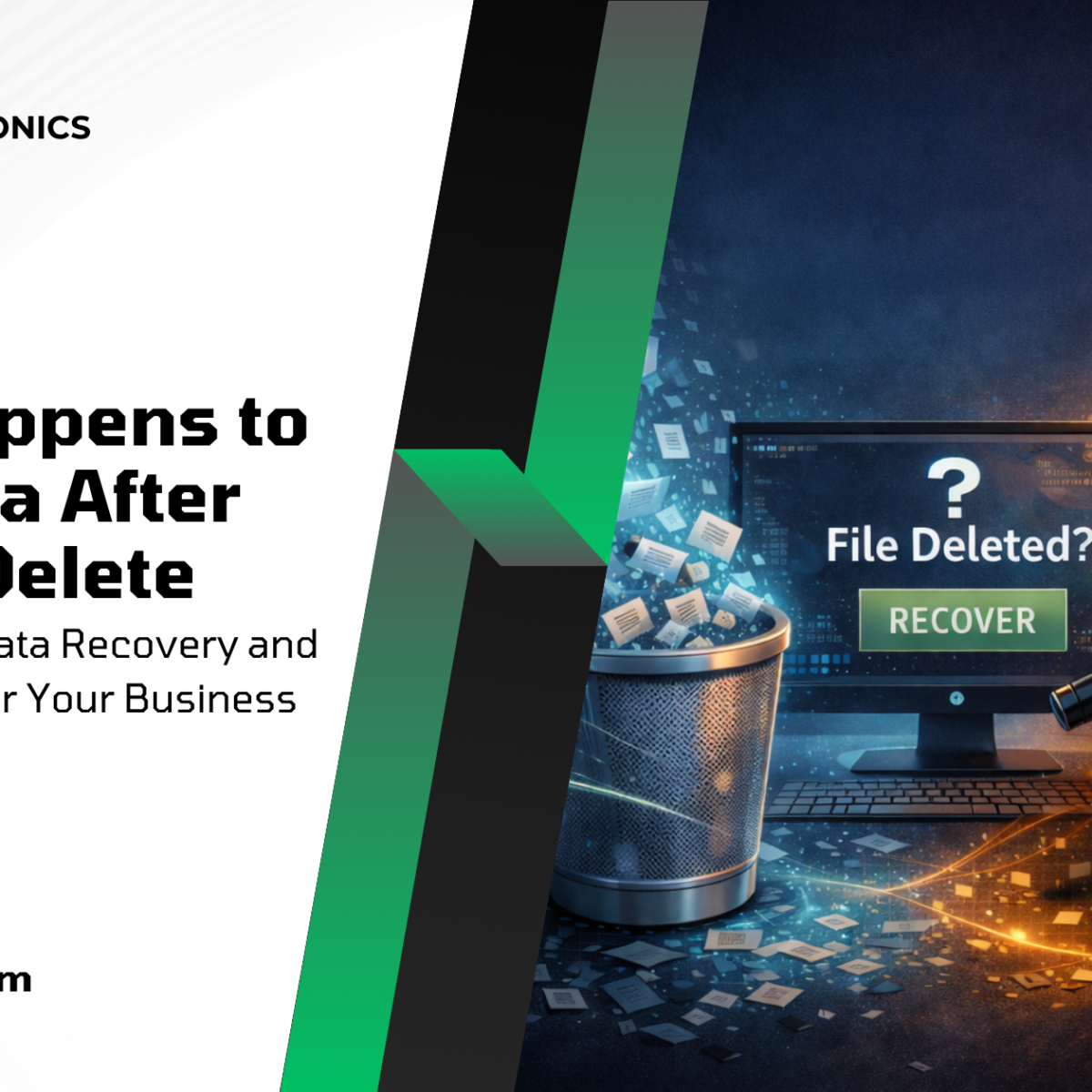
Most people believe that deleting a file makes it disappear. Most businesses operate on the same assumption. When an employee empties the recycle bin, reformats a hard drive before donation, or wipes a phone before trading it in, the instinct is that the data is gone.
It is not. Not without certified sanitization. And the gap between what people believe about deletion and what is technically true is one of the most exploited vulnerabilities in data security today.
Understanding the science of data recovery — how deleted data persists, how it is retrieved, and what it actually takes to make it unrecoverable — is foundational to understanding why IT Asset Disposition matters far more than most organizations realize. This post breaks it down in plain language, with direct implications for how your business should be managing retired hardware.
The Myth of the Delete Key
What “Deleting” a File Actually Does
When you delete a file on a traditional hard disk drive (HDD), the operating system does not erase the data. It simply removes the file’s entry from the directory — the index that tells the system where the file lives on disk. The actual data remains in place on the magnetic platters, unchanged, until the operating system chooses to write new data over that exact location.
Think of it like removing a chapter from a book’s table of contents. The chapter is still there — you just can’t find it through the index anymore. Anyone who knows how to read the raw pages can still find it. Data recovery tools do exactly that: they read raw storage media and reconstruct files the operating system no longer acknowledges.
What Emptying the Recycle Bin Does
Emptying the recycle bin removes the file from the operating system’s secondary index. The data still physically exists on the drive. Recovery software — much of it freely available online — can frequently restore files emptied from the recycle bin minutes, months, or even years later, depending on how much new data has been written to the drive in the interim.
What a “Quick Format” Does
A quick format rewrites the file system structure — essentially creating a new, empty table of contents — but does not overwrite the underlying data. Forensic tools can recover significant amounts of data from a quick-formatted drive. A full format performs a single-pass overwrite, which is more thorough but still does not meet NIST standards for secure sanitization on sensitive data.
Why SSDs and Flash Storage Are Even More Complicated
Solid state drives, USB drives, SD cards, and the flash storage in smartphones and tablets behave differently from traditional hard drives — and in some ways, make complete data destruction harder, not easier.
Wear Leveling
SSDs use a technique called wear leveling to extend the life of flash memory cells by distributing writes evenly across the storage medium. As a result, when data is overwritten, the new data is often written to different physical cells than the original — meaning the original data may remain on cells the operating system no longer tracks. Standard overwrite tools that work on HDDs may not reach this data on an SSD.
Over-Provisioning and Reserved Areas
SSDs reserve a portion of their storage capacity — called over-provisioned space — for internal management functions. This space is inaccessible to the operating system and to standard sanitization tools. Data that migrates into over-provisioned areas during normal use may survive even a full drive encryption and reset.
Mobile Devices and Embedded Flash
Smartphones, tablets, and laptops with soldered-in storage present additional challenges. A standard factory reset removes the user’s access to data but does not necessarily sanitize the underlying flash cells. Research has repeatedly demonstrated recovery of contact lists, messages, photos, and account credentials from “reset” mobile devices purchased through secondary markets.
Real-World Data Recovery: What Has Been Found on Retired Hardware
The gap between perception and reality around data deletion has been documented repeatedly by security researchers and forensic investigators:
- A study of second-hand hard drives purchased from online marketplaces found recoverable personal and business data — including bank account information, medical records, and business contracts — on a significant percentage of drives that had been “deleted” or “formatted” by their previous owners.
- Forensic investigators routinely recover emails, financial records, customer databases, and authentication credentials from enterprise hardware purchased at auction — hardware that was supposed to have been sanitized before resale.
- Healthcare providers have faced HIPAA enforcement actions specifically because patient data was recovered from retired copiers, scanners, and workstations that employees believed had been cleared.
The conclusion is consistent: deletion, formatting, and factory reset are not data destruction. They are data concealment — and imperfect concealment at that.
What Actual Data Destruction Requires
The definitive standard for data sanitization in enterprise environments is NIST SP 800-88 Rev. 1, which defines three levels of sanitization based on media type and data sensitivity:
Clear
Logical overwriting using software tools to write patterns of data over all addressable storage locations. Effective for lower-sensitivity data on HDDs being reused within the same organization. Not sufficient for SSDs or devices leaving organizational control.
Purge
Uses hardware-based techniques or cryptographic erasure to address data in areas inaccessible to standard software tools — including over-provisioned SSD space. Required for moderate-to-high sensitivity data on any media type, especially SSDs, before reuse or transfer.
Destroy
Physical destruction of the media — shredding, disintegration, melting, or incineration – renders recovery impossible regardless of technology. Required for the highest-sensitivity data and for media that cannot be reliably purged. IER’s mobile hard drive shredding service provides on-site destruction with a Certificate of Destruction for every asset processed.
NIST is explicit: the method chosen must match the media type and data classification. A single approach does not work for all hardware. This is why certified ITAD providers develop distinct protocols for HDDs, SSDs, mobile devices, and specialty hardware — and why working with an R2v3-certified provider matters.
Step-by-Step Best Practices: Making Data Truly Unrecoverable
- Classify data before classifying devices. Understand what data each device type has processed. A device that held regulated data — ePHI, PII, financial records — requires a higher sanitization standard than a device used only for internal communications.
- Never rely on deletion, formatting, or factory reset as data destruction. These methods do not meet NIST standards and do not satisfy regulatory disposal requirements under HIPAA, GDPR, PCI DSS, or the FTC Disposal Rule.
- Match sanitization method to media type. HDDs, SSDs, mobile devices, and embedded flash storage each require different approaches. Work with a certified ITAD provider who has distinct protocols for each.
- Require a Certificate of Destruction for every asset. A compliant Certificate of Destruction specifies the asset, the method used, the date of completion, and the certified processor. This is your evidence that data destruction actually occurred.
- Use a NIST 800-88-compliant and R2v3-certified ITAD provider. Certification provides documented, third-party-verified assurance that sanitization was performed to the correct standard for each media type.
- Maintain records for regulatory and insurance purposes. Certificates of Destruction and chain-of-custody records should be retained for a minimum of seven years.
Sustainability and ESG Impact
Understanding why deletion is insufficient actually strengthens the case for device remarketing and certified reuse as a sustainability strategy. Many organizations assume they must physically destroy all retired hardware for security reasons. In reality, NIST SP 800-88 allows for Purge-level sanitization that renders data unrecoverable while leaving the device in working condition for resale or donation.
This means organizations can achieve both security compliance and sustainability outcomes from the same ITAD process:
- Devices sanitized to Purge standard can be remarketed — recovering value while meeting NIST requirements
- Devices that cannot be reliably purged are physically destroyed, and materials are recovered through certified recycling
- Both outcomes are documented and reportable for ESG disclosures
- No device needs to be improperly disposed of to be secure — and no device needs to be insecure to be sustainable
Case Example: What One Unsanitized Laptop Can Cost
A regional accounting firm donated 40 retired laptops to a local organization without performing data sanitization — believing that the IT team had “deleted everything” before the donation. A volunteer at the receiving organization, curious about the devices, ran freely available recovery software on one laptop and found: a client contact database, several years of financial statements, employee W-2 records, and login credentials for the firm’s tax preparation software.
The firm faced a state attorney general investigation, mandatory notification to affected clients, remediation costs, and significant reputational damage — all from a single laptop that an employee had “cleaned.” Had the firm used IER’s certified data destruction service, a NIST-compliant Purge would have rendered the data unrecoverable before the laptops ever left the building — and a Certificate of Destruction would have documented that fact.
FAQs: Data Recovery and Why Deletion Is Not Enough
Q1: Can data be recovered from a hard drive that has been physically damaged?
A: Depending on the nature of the damage, yes. Professional forensic labs can recover data from drives with physical damage — cracked platters, corrupted firmware, water damage — using specialized equipment. Physical destruction through certified shredding to a particle size specified in NIST SP 800-88 is the only method that eliminates this risk entirely.
Q2: Is full disk encryption enough to protect data on a retired device?
A: Encryption significantly raises the bar for data recovery, but it is not a substitute for NIST-compliant sanitization on its own. Cryptographic erasure — destroying the encryption key — can be an effective Purge-level sanitization method for some device types. However, this only works if the encryption was properly implemented before the data was written, and it must be verified. Work with a certified ITAD provider to confirm whether cryptographic erasure meets the standard for your specific device and data classification.
Q3: What about cloud data — does ITAD still matter if we use cloud storage?
A: Yes. Even in cloud-heavy environments, endpoints — laptops, tablets, mobile devices — cache data locally, store authentication credentials, and may retain copies of cloud-synced files. Those devices require the same sanitization standards as any other data-bearing hardware. Additionally, cloud storage itself must be addressed at contract termination — confirmed deletion of cloud data is a separate process from physical device sanitization.
Q4: How do I know if a data recovery attempt has been made on a retired device?
A: In most cases, you would not know unless forensic analysis was performed. This is precisely why prevention — certified sanitization before any device leaves organizational control — is the only reliable strategy. There is no way to retroactively detect whether data on an improperly disposed device has been accessed.
Q5: Does the age of a hard drive affect the recoverability of data on it?
A: Age affects recoverability, but not as much as most people assume. Data on a magnetic HDD can remain recoverable for years after deletion if it has not been overwritten. SSDs with wear leveling may retain data in specific cells indefinitely unless properly purged. The medium matters more than the age, and certified sanitization appropriate to the media type is always the correct approach, regardless of how old the device is.
Conclusion
Deletion is not destruction. Formatting is not sanitization. A factory reset is not data erasure. These are not technicalities — they are the gaps that breaches, regulatory violations, and insurance claims fall through.
Every organization that retires IT hardware carries the responsibility to ensure that the data on that hardware is rendered truly unrecoverable before it leaves organizational control. NIST SP 800-88 defines the standard. R2v3-certified ITAD providers implement it. And Certificates of Destruction document that it happened.
The science is clear. The standard exists. The solution is available. The only question is whether your organization is using it.
Call to Action
Ready to make data deletion actually mean something? Contact IER ITAD Electronics Recycling — Colorado Springs Electronic Recycling and your partners in certified data destruction and NIST-compliant IT asset disposition — to ensure every retired device your organization touches is truly, verifiably clean.